
How to Calculate Your Pregnancy Due Date
Every pregnancy due date calculator does the same thing: finds the date you will reach 40 weeks of gestation. What changes is the starting point. Pick the method that matches the most reliable date you have.

Anchors the date in Pregnancy Calculator
Your LMP, conception date, or ultrasound-derived gestational age becomes Day 0.
Adjusts for cycle length
Naegele’s rule assumes ovulation on day 14 of a 28-day cycle. Entering your actual average cycle length shifts the EDD by the difference.
Reports gestational age
Today’s date minus Day 0 gives completed weeks plus days, plus the current trimester.
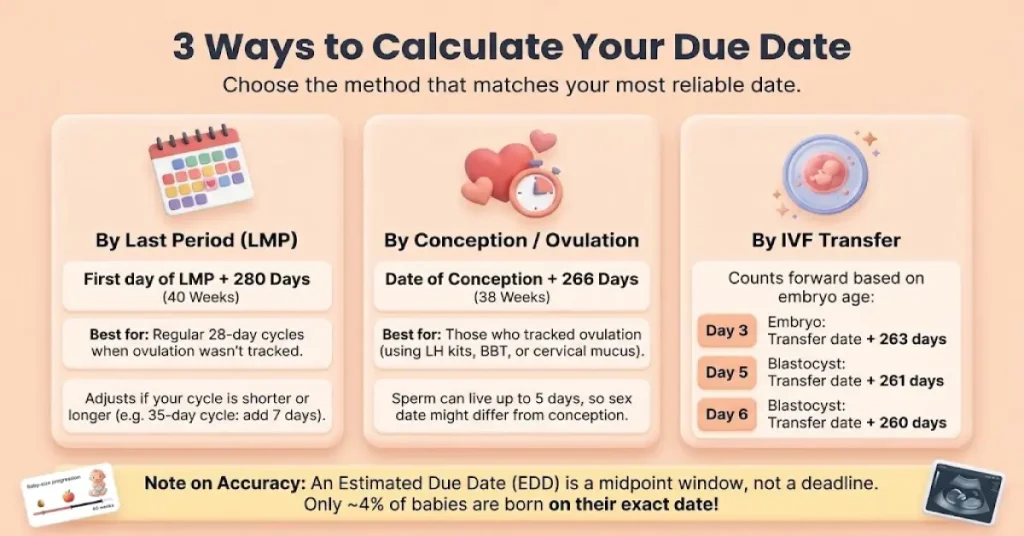
An EDD is a midpoint, not a deadline. Only about 4% of babies are born on their exact EDD, and delivery between 37 weeks 0 days and 42 weeks 0 days falls within the normal range. First-trimester ultrasound crown-rump length (CRL) is the most accurate dating tool, measuring gestational age within about ±5 to 7 days. When an ultrasound differs from the LMP date beyond ACOG redating thresholds, clinicians use the ultrasound date. See ultrasound due date accuracy for the thresholds.
Calculation by Last Menstrual Period (LMP)
Most online pregnancy calculators start here, because most people remember when their last period began, while very few know exactly when they ovulated. A last menstrual period calculator counts from day 1 of your last period (the first day of full bleeding, not spotting).
Naegele’s Rule in Pregnancy Calculator
Naegele’s rule calculates the estimated due date from the first day of the LMP in four steps:
Example: An LMP of March 10 becomes March 17, then December 17. This is the same as adding 280 days.
Naegele’s rule assumes a 28-day cycle with ovulation around day 14. If your cycle is consistently shorter or longer, ovulation likely happened earlier or later, and the due date shifts by roughly the same number of days:
|
Typical Cycle Length |
Approximate Adjustment |
|---|---|
|
24 days |
About 4 days earlier |
|
26 days |
About 2 days earlier |
|
28 days |
None |
|
30 days |
About 2 days later |
|
32 days |
About 4 days later |
|
35 days |
About 7 days later |
Not sure what your average cycle length is? Our period cycle calculator works it out from your recent start dates.
This adjustment only makes sense for regular cycles. If your periods are irregular, you recently stopped hormonal birth control, or you conceived while breastfeeding, your LMP is a weak starting point. In those cases, an LMP-based pregnancy week calculator will give you only a rough placeholder, and an early ultrasound should confirm the date.
Calculation by Conception Date or Ovulation
If you know when you ovulated or conceived, you can skip guessing your cycle length. Add about 266 days (38 weeks) to the ovulation or conception date to estimate your due date. Ovulation timing varies, so this is still an estimate, just a better-anchored one.
Ways people identify ovulation include:
- Ovulation predictor (LH) kits
- Basal body temperature charting
- Cervical mucus tracking
- An ovulation calculator, which estimates your fertile window from your cycle length
A note on intercourse dates
Sex on a particular day does not mean conception happened that day. Sperm can survive in the reproductive tract for up to five days, so fertilization can occur days after intercourse. A single intercourse date is therefore not the same as a confirmed conception date, and any due date calculated from it is a rough estimate. If you only have intercourse dates, the conception calculator can show the range of likely conception days and the due date from conception that goes with them.
Calculation for IVF Transfers (Day 3 vs. Day 5)
With IVF, the embryo’s age on the day of transfer is known, so dating does not rely on an estimate of ovulation. An IVF due date calculator counts forward from the transfer date, adjusting for the embryo’s age:
|
Transfer Type |
Embryo Age |
Due Date |
|---|---|---|
|
Day 3 embryo (cleavage stage) |
3 days |
Transfer date + 263 days |
|
Day 5 blastocyst |
5 days |
Transfer date + 261 days |
|
Day 6 blastocyst |
6 days |
Transfer date + 260 days |
For intrauterine insemination (IUI), the usual approach is insemination date plus 266 days. Your fertility clinic will normally give you an official EDD, and that date should take priority over any online result.
How Far Along Am I? (Gestation vs. Fetal Age)
A how far along am I calculator reports gestational age, which is usually about two weeks ahead of the embryo’s actual age.
|
Term |
Counted From |
Used By |
|---|---|---|
|
Gestational age |
First day of the last menstrual period |
Clinicians, ultrasound reports, most calculators |
|
Fetal (embryonic) age |
Conception |
Developmental research, some embryology resources |
Why Gestational Age Includes the Two Weeks Before Conception
On the day you conceive, you are already counted as roughly 2 weeks pregnant. This convention exists because the LMP is a date you can observe and write down, while ovulation and conception usually are not. It gives every pregnancy the same clock.
The practical effect: when a gestational age calculator says you are 6 weeks pregnant, the embryo is about 4 weeks old. It also explains why a positive test around your missed period comes at “4 weeks.” If your week count looks two weeks “too high” compared with what you expected, this is almost always the reason.
To see your exact number, use the calculator at the top of this page or enter your dates into the conception calculator if you are working back from conception.
How Many Weeks Is Full-Term Pregnancy?
A pregnancy lasts about 40 weeks, but “full term” is a narrower window than most people assume. ACOG separates term pregnancy into four categories:
|
Classification |
Gestational Age |
|---|---|
|
Early term |
37 weeks 0 days to 38 weeks 6 days |
|
Full term |
39 weeks 0 days to 40 weeks 6 days |
|
Late term |
41 weeks 0 days to 41 weeks 6 days |
|
Postterm |
42 weeks 0 days and beyond |
|
Preterm (for reference) |
Before 37 weeks 0 days |
These labels matter because outcomes are best when pregnancy continues to at least 39 weeks unless there is a medical reason to deliver sooner. Babies born at 37 or 38 weeks are generally healthy but carry a slightly higher chance of breathing and feeding difficulties than those born at 39 to 40 weeks.
Pregnancy Weeks to Months Conversion Chart in Pregnancy Calculator
Providers count in weeks, while family, employers, and friends count in months. The two do not match neatly because a calendar month is about 4.35 weeks, not 4. The conversions below are approximate.
|
Weeks |
Approx. Months |
Trimester |
|---|---|---|
|
8 |
~2 |
First |
|
13 |
~3 |
First |
|
20 |
~4.6 |
Second |
|
27 |
~6.2 |
Second |
|
28 |
~6.4 |
Third |
|
36 |
8.3 |
Third |
|
40 |
~9.2 |
Third |
How Accurate Are Online Due Date Calculators?
The arithmetic in an online calculator is exact. The uncertainty is biological: ovulation does not happen on the same day for everyone, and even in regular cycles it can vary by several days. A calculator can only be as accurate as the date you give it, and what that date assumes.
Treat any result from an EDD calculator or estimated due date calculator as a planning estimate until your provider confirms it.
Due Date Predictor vs. First-Trimester Ultrasound Accuracy
An LMP-based due date predictor assumes you ovulated on day 14. An ultrasound measures the embryo itself. In the first trimester, embryos grow at a very consistent rate, so the crown-rump length (CRL), the measurement from the top of the head to the bottom, is a more reliable indicator of gestational age than the calendar.
ACOG identifies a first-trimester ultrasound as the most accurate method of establishing or confirming gestational age, and sets out when an ultrasound should replace the LMP date. The threshold depends on how far along you were at the scan:
|
Gestational Age at Scan |
When to Adjust Due Date |
|---|---|
|
Up to 8 weeks 6 days |
5 days |
|
9 weeks 0 days to 13 weeks 6 days |
7 days |
|
14 weeks 0 days to 15 weeks 6 days |
7 days |
|
16 weeks 0 days to 21 weeks 6 days |
10 days |
|
22 weeks 0 days to 27 weeks 6 days |
14 days |
|
28 weeks 0 days and beyond |
21 days |
Once an early scan has set the due date, it is generally not changed by later scans. Babies grow at different rates as pregnancy goes on, so a baby measuring large or small at 30 weeks does not mean the dates were wrong.
These recommendations come from ACOG’s guidance on methods for estimating the due date, which is worth reading if you want the clinical detail. Our guide to ultrasound due date accuracy explains in plain language what happens at a dating scan and why your date might move.
Your EDD Is a Midpoint, Not a Deadline
Only around 4% of babies arrive on their exact due date. Most are born within a couple of weeks either side of it, and spontaneous labor between 37 and 42 weeks is considered normal. First pregnancies tend to run slightly longer, on average, than later ones.
A calculator can also run alongside blood testing
If you are in early pregnancy and want to see reference ranges for rising hormone levels, the hCG levels calculator shows typical values. hCG varies widely between people, so it cannot be used to date a pregnancy.
Frequently Asked Questions About Pregnancy Calculator Dating
When’s my due date according to Pregnancy Calculator?
Add 280 days to the first day of your last period, or about 266 days to your ovulation or conception date. The calculator at the top of this page does both. For an IVF pregnancy, count from your transfer date as shown in the table above. Your provider’s confirmed date overrides any online estimate.
How do I calculate how many weeks pregnant I am?
Count the days from the first day of your last period to today and divide by 7. In (Pregnancy Calculator), the whole number is your completed weeks, and the remainder is extra days. For example, 100 days is 14 weeks and 2 days. A pregnancy weeks calculator does this automatically.
What if my cycle isn’t 28 days?
For regular cycles longer or shorter than 28 days, adjust the due date by about the same number of days (see the table in the LMP section). If your cycle length varies from month to month, LMP dating is unreliable, and an ultrasound will give you a better date.
What if my periods are irregular, or I got pregnant after stopping birth control?
LMP is not dependable in these situations. Book an early dating ultrasound as soon as you have a positive test and use that date, rather than a calculator result, for planning.
Can my due date change from the result of a pregnancy calculator?
Yes. If a dating ultrasound differs from your LMP date by more than the thresholds shown above, your provider will usually move the due date to match the scan. After that, the date normally stays the same for the rest of the pregnancy.
Should I trust the calculator or my doctor?
Your doctor. A Pregnancy Calculator can only process what you type in. Your provider can combine your cycle history, an exam, and ultrasound measurements. Use the online result for planning until your provider confirms a date.
Does the calculator work for twins or IVF?
Dating works the same way, but twins are often delivered earlier, commonly between 36 and 38 weeks depending on the type of twin pregnancy, so your provider will plan around that. For IVF, use the transfer date and embryo age rather than LMP.
How accurate is a baby calculator due date?
The arithmetic is exact, but the result is a prediction. A due date based on a first-trimester ultrasound or a known IVF transfer date is the most dependable. An LMP-only date is the least certain if your cycles are irregular.
Conclusions of Pregnancy Calculator
A pregnancy calculator is a starting point, not a verdict. Enter the best date you have: your LMP if your cycles are regular, your ovulation or conception date if you tracked it, or your transfer date for IVF. Expect a due date that is the middle of a window, and let a first-trimester ultrasound and your provider’s judgment set the final date.
use Zefoy Tiktok Tool